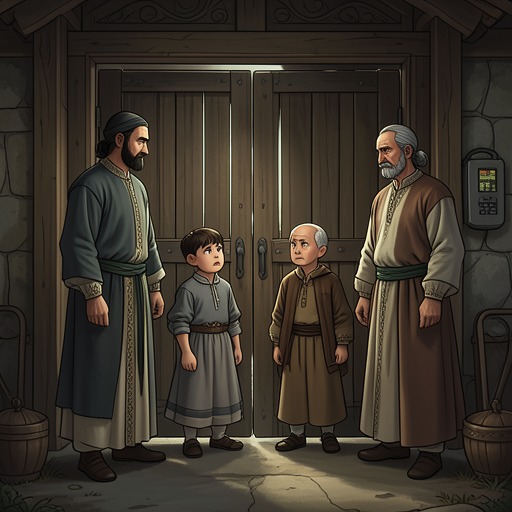
Anna’s death after eating the christening porridge
The EmigrantsAnna’s death after eating the christening porridge turns a rare household treat into a family catastrophe. Four-year-old Anna, left alone while her parents attended to chores, secretly ate most of the barley porridge Kristina had saved for her brother Harald’s christening. After becoming gravely ill, Anna died early the next morning. Her death exposes the terrible reach of hunger into domestic life and becomes a turning point in Kristina’s decision to leave home for North America.
The christening meal
The porridge was prepared for Harald’s christening during a winter of scarcity. Kristina had kept barley grains in a small sack for the occasion and added the little butter and sugar available to her. The children had not tasted food like it for a long time. She poured the porridge into a large earthen bowl and placed it in the cellar to cool, intending to serve it after the godparents returned from church. The ceremony was modest: Jonas Petter and Brita-Stafva of Hästebäck were the godparents, and Karl Oskar’s sister Lydia was the only other guest.
While Karl Oskar and Kristina were working in the byre, the children were alone inside. When the parents returned, Anna was missing. She did not usually leave the farm without permission, and Karl Oskar was especially troubled: she was his constant companion in his work, and he had promised to take her to the cobbler that day to have her feet measured for new shoes. After they searched without finding her, Kristina heard faint crying in the cellar and discovered Anna beside the earthen bowl, now mostly empty.
Hunger, disobedience, and illness
Anna explained that she had first gone down to smell the porridge, then tasted a little. She had meant to take so little that no one would notice, but once she began eating she could not stop. When she realized what she had done, she was afraid to return to the house and stayed in the cellar. The hunger that drew her to the bowl was inseparable from the hardship of the winter: after a long period of famine food, the rich barley porridge proved too much for her.
Her parents carried her into the house and put her to bed. As her pain worsened, Anna repeatedly asked them to forgive her for disobeying the instruction not to touch the porridge before the evening gathering. Berta of Idemo tried remedies for her stomach, but the child’s suffering continued. Berta warned the family that she could not promise to heal the damage. During the night Anna became delirious at intervals. When she heard that God might take her home if she did not improve, she said she wanted to stay. She also asked her father to help her get up and go to the cobbler for the promised shoe measurements. Anna died early the next morning.
Grief and silence
Karl Oskar withdrew into grief in the days that followed, often unable to answer people who spoke to him. When Nils asked whether he should make Anna’s coffin, Karl Oskar answered that he wanted to make it himself. The task gave him something definite to do for his dead child when little else could be thought of.
Kristina was crushed for weeks after the funeral. She repeatedly blamed herself, wondering whether Anna would have lived if she had hidden the bowl or let the children taste the porridge before putting it away. The parents did not speak Anna’s name for a long time. Their silence was not forgetfulness: they kept the loss from being brought into the open because speaking of it seemed to make the sorrow heavier, rather than relieve it.
A changed decision
The death also altered how the parents understood the danger facing their family. Karl Oskar saw Anna’s death as evidence that the land itself was cursed; he compared her fate with that of other hungry children and recognized that even food could not free her from hunger’s consequences. The belief that God had foreordained events was already part of the family’s world: Nils, for example, accepted his own disabling accident as something he must not presume to question. Yet the family’s religious explanations did not undo the immediate fact of loss or settle what it meant for their future.
A month after Anna’s funeral, Kristina told Karl Oskar that she had changed her mind about emigrating. She had previously feared that taking the children across the ocean would put their lives at risk. Now she understood that God could take a child on dry land despite a mother’s care, and believed the children could be equally safe at sea if entrusted to God. She also knew that she would not feel the same in their home after Anna’s death. Kristina agreed to go with Karl Oskar, while acknowledging that they could not know what awaited them.
The loss carried forward
Anna’s death remains present in later moments of the family’s life. When Kristina recalled the chain of events that had led her to Karl Oskar—from a fall in a swing at Duvemåla to seeking a cure in Idemo—she counted Anna among the children sleeping beside her and understood her own history through the providence she believed had guided it. The memory of the child also returns during the family’s later ordeal at sea: as Kristina faces a life-threatening hemorrhage, Karl Oskar remembers that he persuaded his wife and children to emigrate and feels the weight of having taken responsibility for their voyage.
The contrast is stark. At Korpamoen, Anna’s death follows a moment of desperate appetite in a household with too little food; at sea, the family faces a different set of dangers, including overcrowded quarters and strict weekly provisions. Across these circumstances, the narrative gives hunger and peril concrete domestic and material forms rather than treating emigration as an abstract choice. Anna’s death does not simply precede the family’s departure: it changes what safety means to Kristina and helps make leaving possible, while the memory of loss continues to burden Karl Oskar as he carries his family toward an uncertain future.